savage glitter
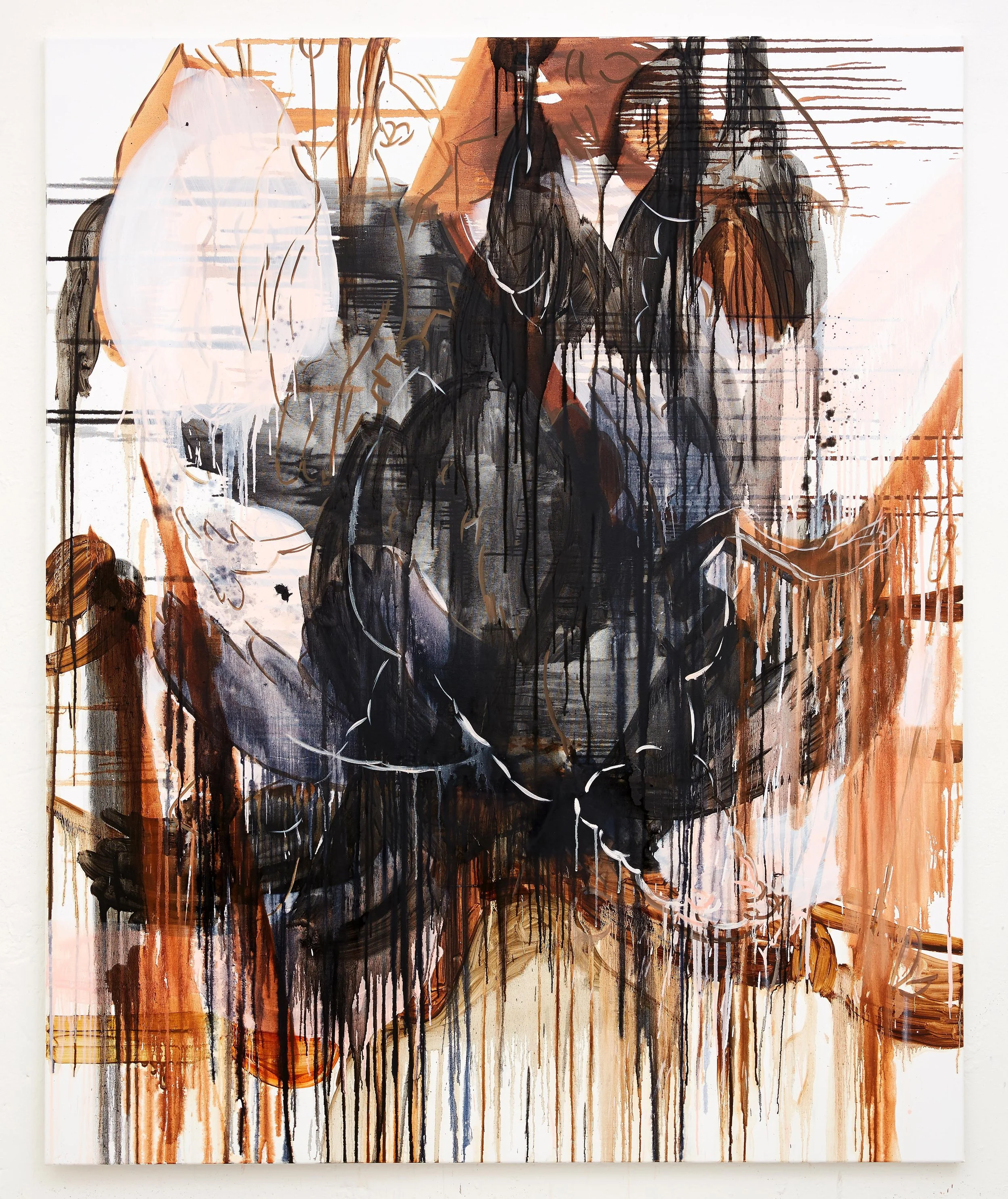
Savage Glitter, oil on canvas, 190 × 155 cm
She was never going to seek gainful employment again, that was for certain. She'd remain outside the public sector. She'd be an anarchist, she'd travel with jaguars. She was going to train herself to be totally irrational. She'd fall in love with a totally inappropriate person. She'd really work on it, but abandon would be involved as well. She'd have different names, a.k.a. Snake, a.k.a. Snow no that was juvenile. She wanted to be extraordinary, to possess a savage glitter.
Joy Williams, The Quick and the Dead
Savage Glitter
Marie Irmgard Birkedal
Galerie1214
Alexandrinenstraße 1
10969 Berlin
Opening
26 April 2018
18:00–21:00
Exhibition
27 April – 1 June 2018
Gallery Weekend Berlin
27–29 April 2018
Friday–Sunday, 11:00–19:00
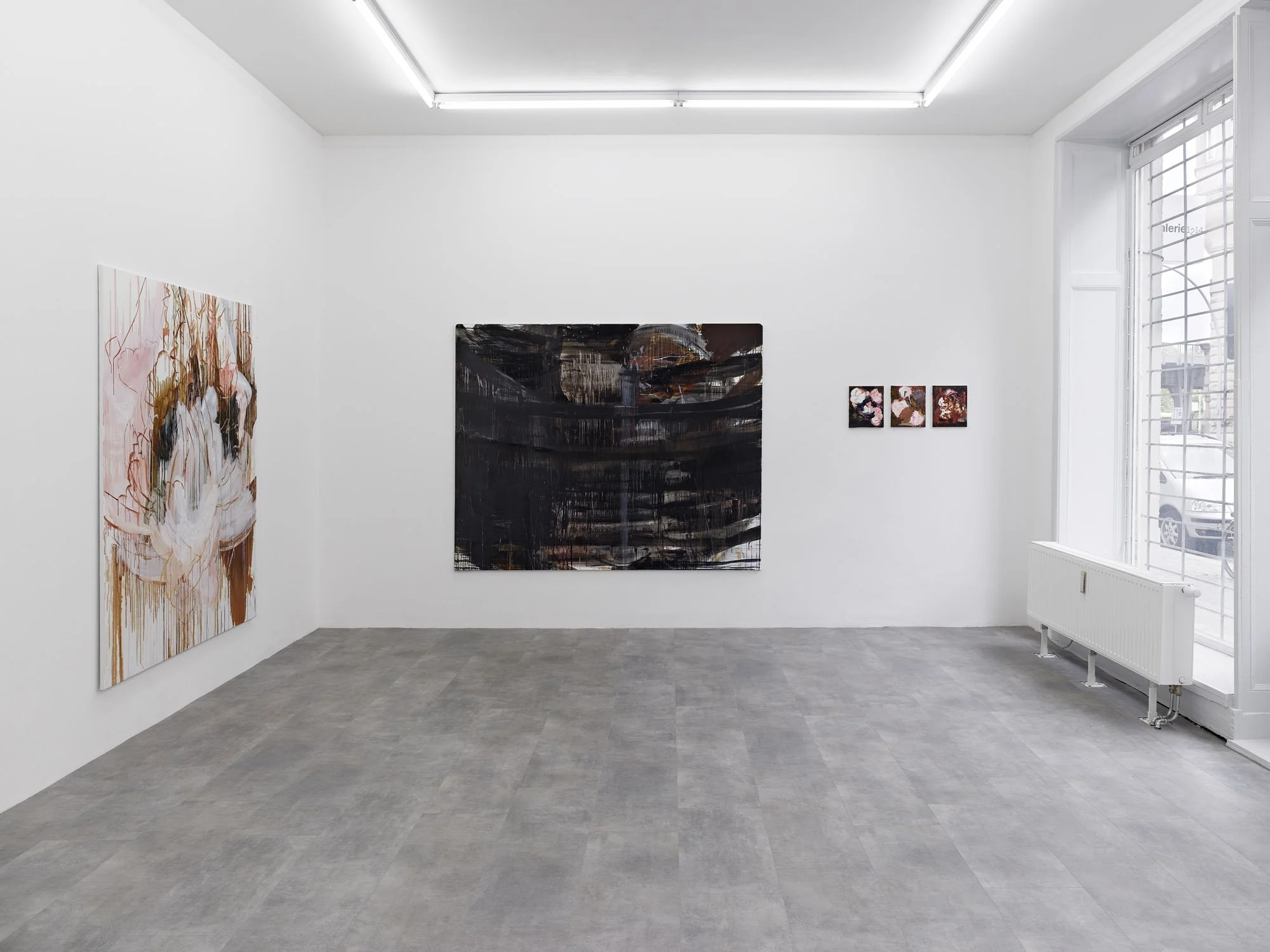
installation view, courtesy of Galerie 1214
Art | History | Looking
Dr. phil. Peter Kohlhaas
© Galerie1214, 2018
Marie Irmgard Birkedal grew up in Copenhagen, studied English, art history and art, travelled extensively in the United States, and has participated in numerous solo and group exhibitions in Scandinavia since 2003. She has lived in Berlin since 2013.
Birkedal’s work encompasses approaches ranging from conceptual work and photography to painting. She works within an artistic and historical continuum, drawing on a coordinate system broad enough to include figures as different as Cy Twombly, Diego Velázquez and Yoko Ono.
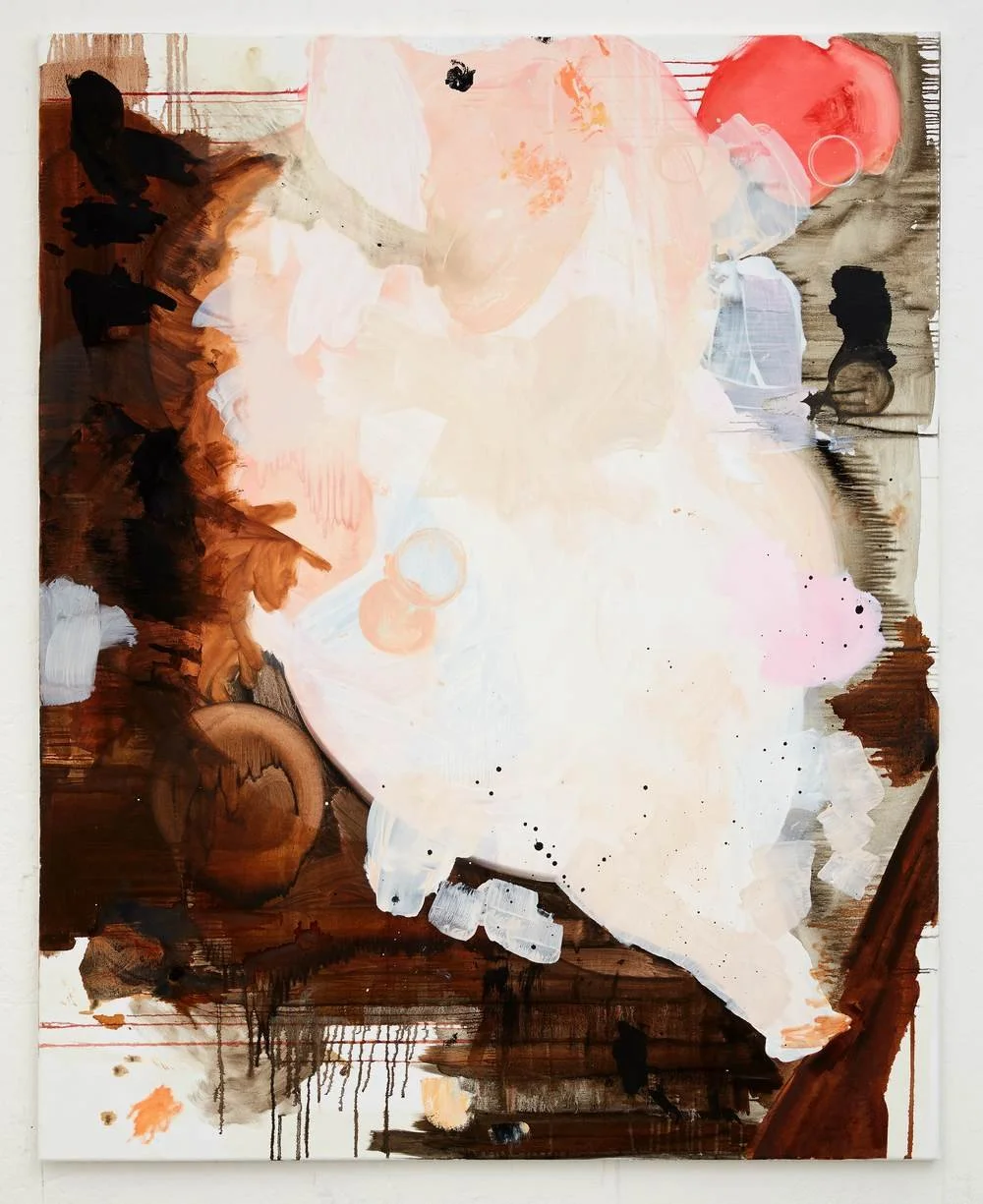
Hummingbirds (El Rito), oil on canvas, 150 × 120 cm
In her recent works on canvas and paper, Birkedal develops a specifically painterly approach to the formation of the image. Alongside impasto applications of paint, she frequently works with paint heavily diluted with linseed oil. Large formats have become increasingly important, although they are not exclusive.
The emergence of the image is delayed and slowed down. Content, surface and colour are subjected to time.
Literary criticism uses the expression “God’s-eye view” to describe a narrative perspective from which characters and events appear entirely transparent and, within the logic of the narrative, factual: everything is known and weighed.
The closest equivalent in visual art might be found in medieval pictorial narratives, which create a comprehensive simultaneity through the juxtaposition of spaces and events. The painter becomes their omniscient chronicler.
Cubism formulated another version of this claim. Its interlocking perspectives were intended as a means of making visible the conditions of modern life. Or, as Guillaume Apollinaire put it succinctly: Cubism is a realism.
In her painting, Marie Irmgard Birkedal follows a different path in relation to the possibility of representing the world as a totality.
The origin of this path lies in the fact that Birkedal occupies a position outside the polarity of assertion and counter-assertion A versus non-A. It is rooted instead in an aesthetic of astonishment.
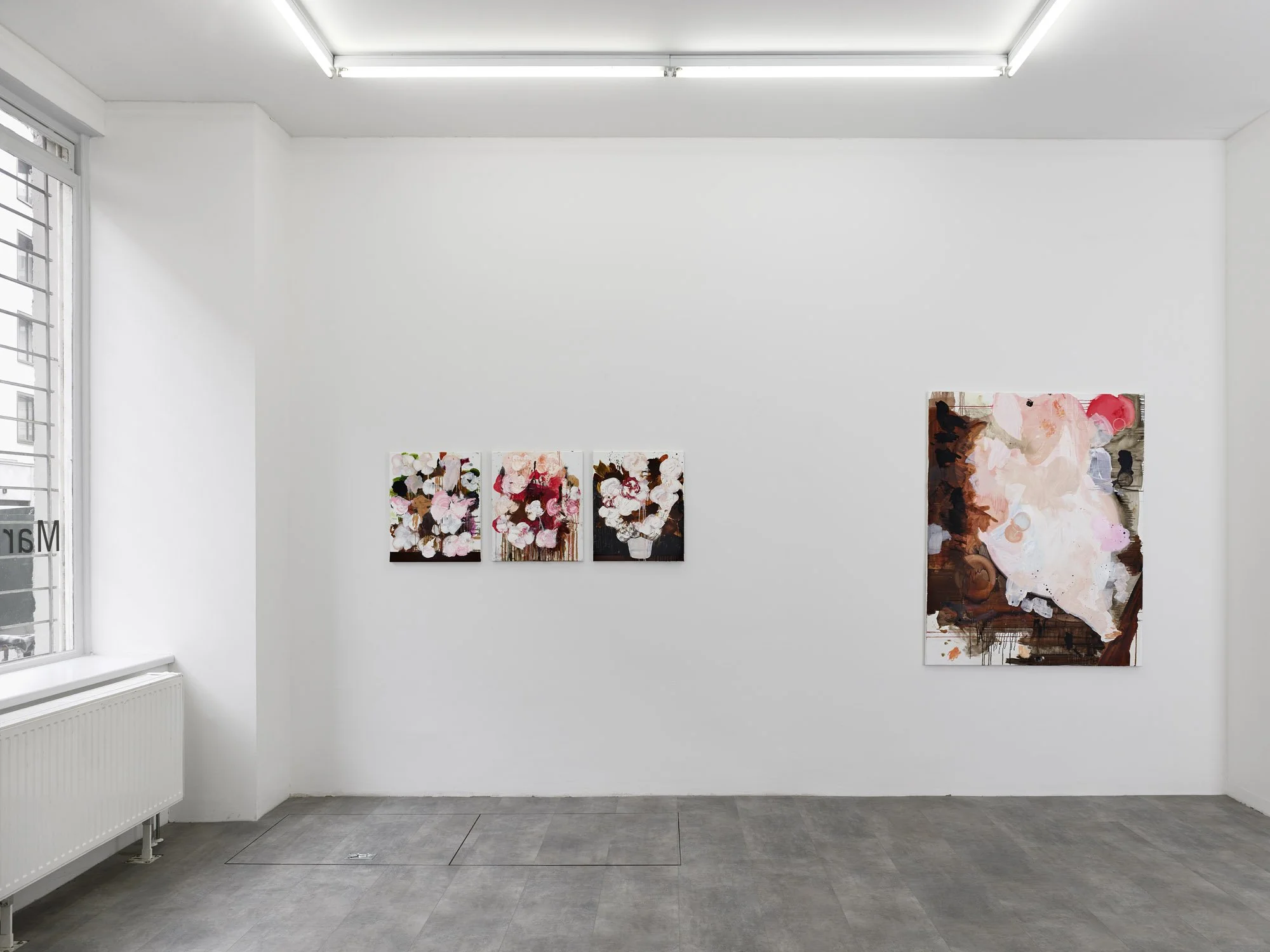
installation view, courtesy of Galerie 1214
In an interview published in 2016, in which she discusses the motivations behind her working method, she says:
“To me, passive astonishment is a transcendentalist’s outlook. (...) I look a lot at nature’s ‘visual design’ the outlines of dog paws, horses’ cannon bones, cat skulls and bird feathers never lose their fascination for me. The same goes for some foods a broken egg, a mango cut in half, an eggplant to me there’s everything in that. I can look and look and I still don’t quite get it but I don’t mind that I don’t get it. As long as I can keep looking, there is no frustration in that look. It’s very much about being in a state where not understanding, or ever expecting to understand, but simply observing and admiring, is okay.”
One might be tempted to describe this in terms of subjectivity or subjectification, but this is not precisely Birkedal’s concern.
Her underlying insight which may also have something to do with feminism and with a subtle reflection on her own biography is that subjectivism in painting is not radical enough.
Beyond the assertive gesture, artistic practice can remain centrifugal: distracting, dispersive and ultimately consumerist, unable to resolve fundamental doubts about the emancipatory power routinely attributed to art.
Less elevated terms for an alternative might simply be curiosity and multiplicity.
Subjectivism in art does not necessarily reach the roots of basic human needs; at most, when successfully handled, it may produce their parody. In this sense it remains centrifugal.
Astonishment, by contrast, has another direction. It opens outward while simultaneously concentrating attention. It is centripetal. It exposes itself to the gravity of actual experience, whatever may come.
To be astonished means to observe and to wait.
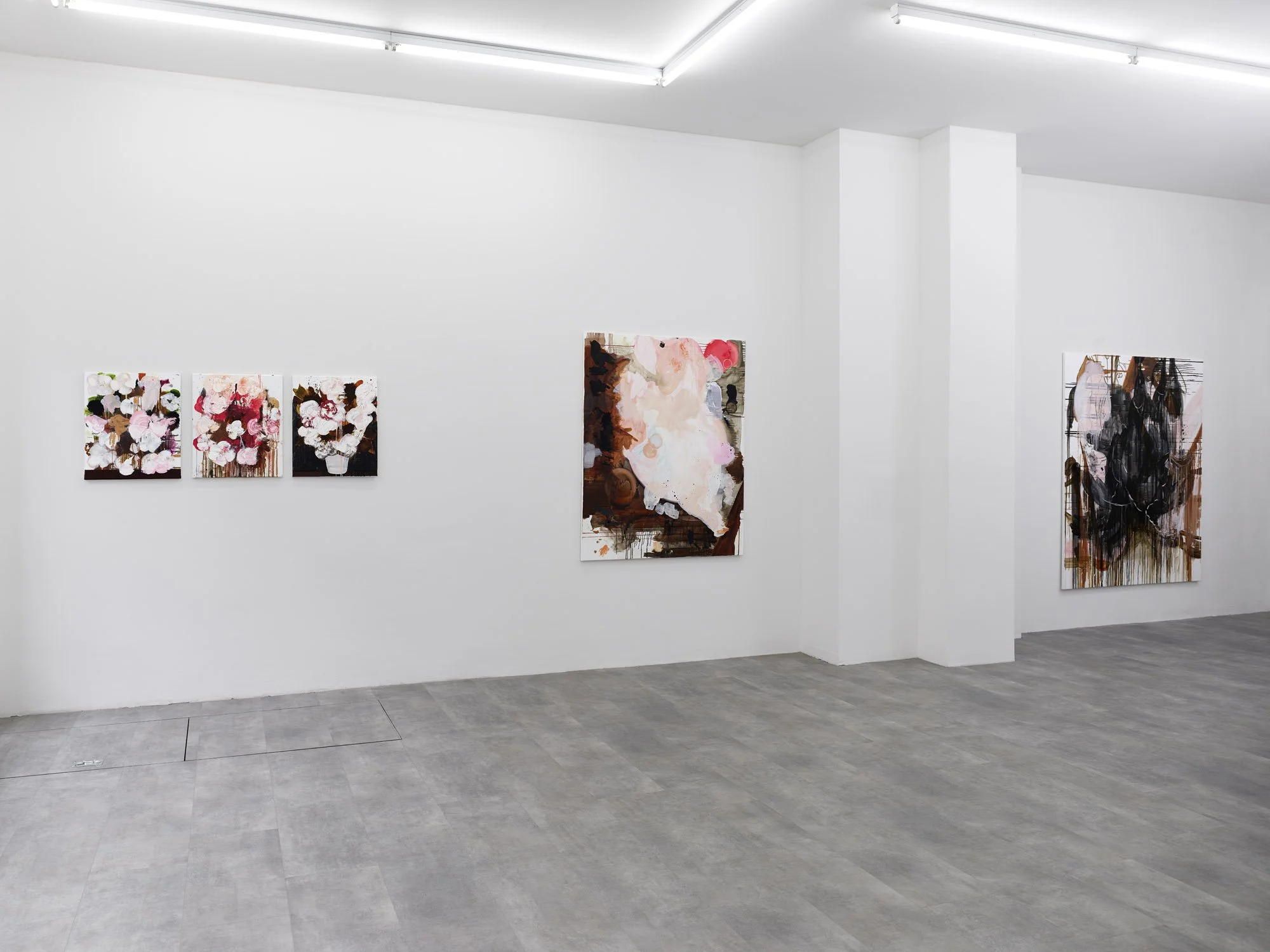
installation view, courtesy of Galerie 1214
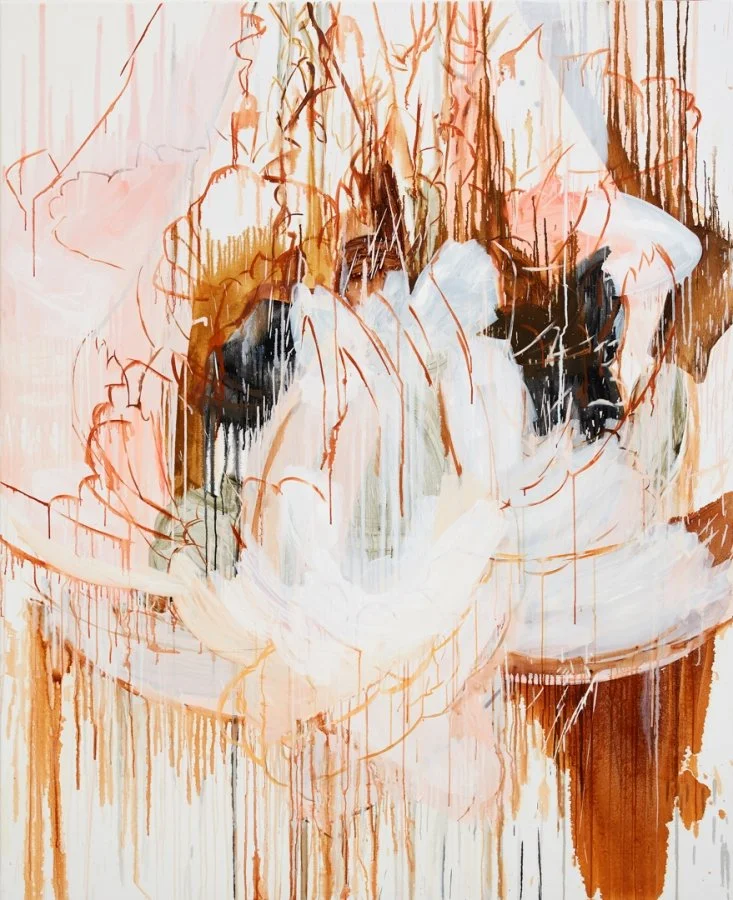
After Willem van Aelst, oil on canvas, 190 × 155 cm
Wait
Painting from a position of astonishment cannot remain indifferent to the painting process.
In many of her recent works, Birkedal uses linseed oil as a painting medium. Its long drying time can considerably delay the development of the work.
As a consequence, certain formal decisions, as well as the achievement of precisely intended colour values, can neither be arbitrarily accelerated nor simply terminated.
The wet consistency of diluted paint facilitates painterly gesture and rapid brushwork. At the same time, it becomes a means of refusing to accept the first gestural impulse automatically as the final result.
The movement of the painting hand changes repeatedly as Birkedal tests how each gesture ultimately enters into the whole.
When asked whether she has time, Birkedal often replies that she has to wait anyway: a painting is drying and cannot be worked on again until the material permits the next step.
This suspended state characterises both her working method and her painterly technique.
Respect here does not function as an empty formula, but as sustained concentration on an open process that intention and the hand have set in motion.
Astonishment and observation therefore require waiting as a fundamental condition of the work.
Within the dominant Western conception of time, waiting often appears to be an imposition: empty, lost or pointlessly passing time.
As Ralf Konersmann writes, “Waiting, according to the standard perception, is empty, lost, pointlessly elapsing time.”
Birkedal, by contrast, incorporates waiting into her practice as a condition almost as a substance that the work itself absorbs.
Studio practice gives waiting a material form through painting technique.
By delaying the drying of the paint, Birkedal slows down the material process and intensifies the intellectual one.
This also permits several paintings to develop simultaneously.
The evolution of each work is therefore determined both by its own particular situation and by painterly discoveries made across several works.
Observation may lose itself in detail. It may, in Schiller’s sense, be naïve. At the same time, it can move beyond the individual work toward reflection and dialogue, where Birkedal’s perception of the whole approaches both historical and contemporary sources of her painterly impulse.
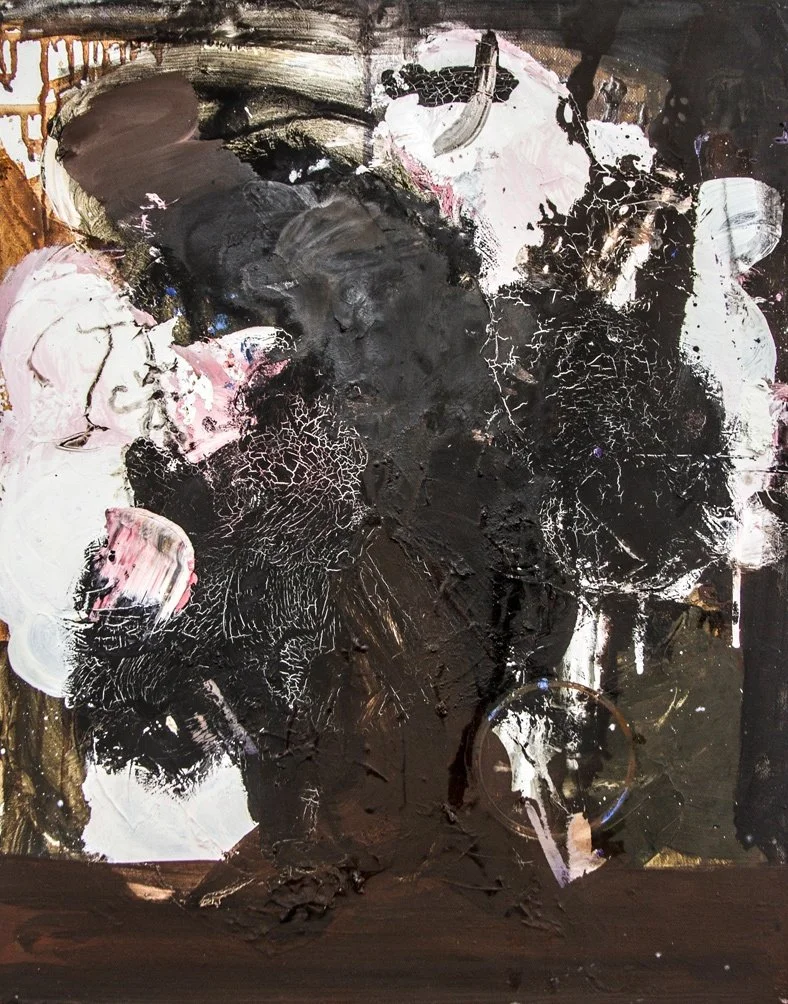
Black Peonies, oil on canvas, 60 × 50 cm
Surface: I can look and look …
To wait, under these conditions, means to draw time just as one might draw breath or draw hope from a continuously renewing source.
Empty time the measurable time of clocks does not renew itself.
Waiting becomes charged with energy through observation, creating the conditions for the subsequent process of gradual condensation.
Birkedal herself uses the paired terms observing / admiring, distinguishing an open form of attention before judgement from both an analytical approach and a prematurely fixed interpretation.
Here she introduces a term closely associated with Andy Warhol, but appropriates and expands it into the sphere of social interaction and reflection.
A broken egg, an eggplant or a still life may unquestionably be worthy of sustained attention.
Warhol’s gesture, as a historical act, cannot simply be repeated. At most it could be copied, and that is not Birkedal’s concern.
What interests her is the force contained within that gesture and the possibility of preserving or reactivating it within contemporary painting.
By creating time, a space for action emerges in which the interaction between content, form and painterly elements can be explored.
This is also evident in Birkedal’s deliberate use of series, in which painting is, in a sense, allowed to observe itself.
A dialogue develops between the painter’s intentional impulses, historical models and points of reference Velázquez is an important example, as are Baroque still lifes and the immediate material process of painting.
Birkedal’s approach makes visible a polarity between the gesture of the hand, preserved in the visible traces of making, and the autonomy of a surface event that is prepared and supported but simultaneously proceeds “by itself” according to physical and chemical principles.
Colours mix and penetrate one another. Microstructures develop within the ground. Paint runs. Cracks and craquelure appear. Rhizomatic effects produce fine networks of lines that seem to promise order.
These processes must be understood together with the broad brushstrokes that construct pictorial space across formats extending beyond the reach of two outstretched arms.
In her painting, Birkedal avoids treating the surface as a statement.
Instead, the surface initially asks simply to be visible.
It does not become discursive in the sense of offering fixed meanings or content that demand binding interpretation.
The surfaces present themselves as contributions to an ongoing dialogue between the painter and the world from inanimate nature to history and art history.
They resist a fixed narrative programme, or perhaps open one so extensively that sufficient space remains for the individual viewer.
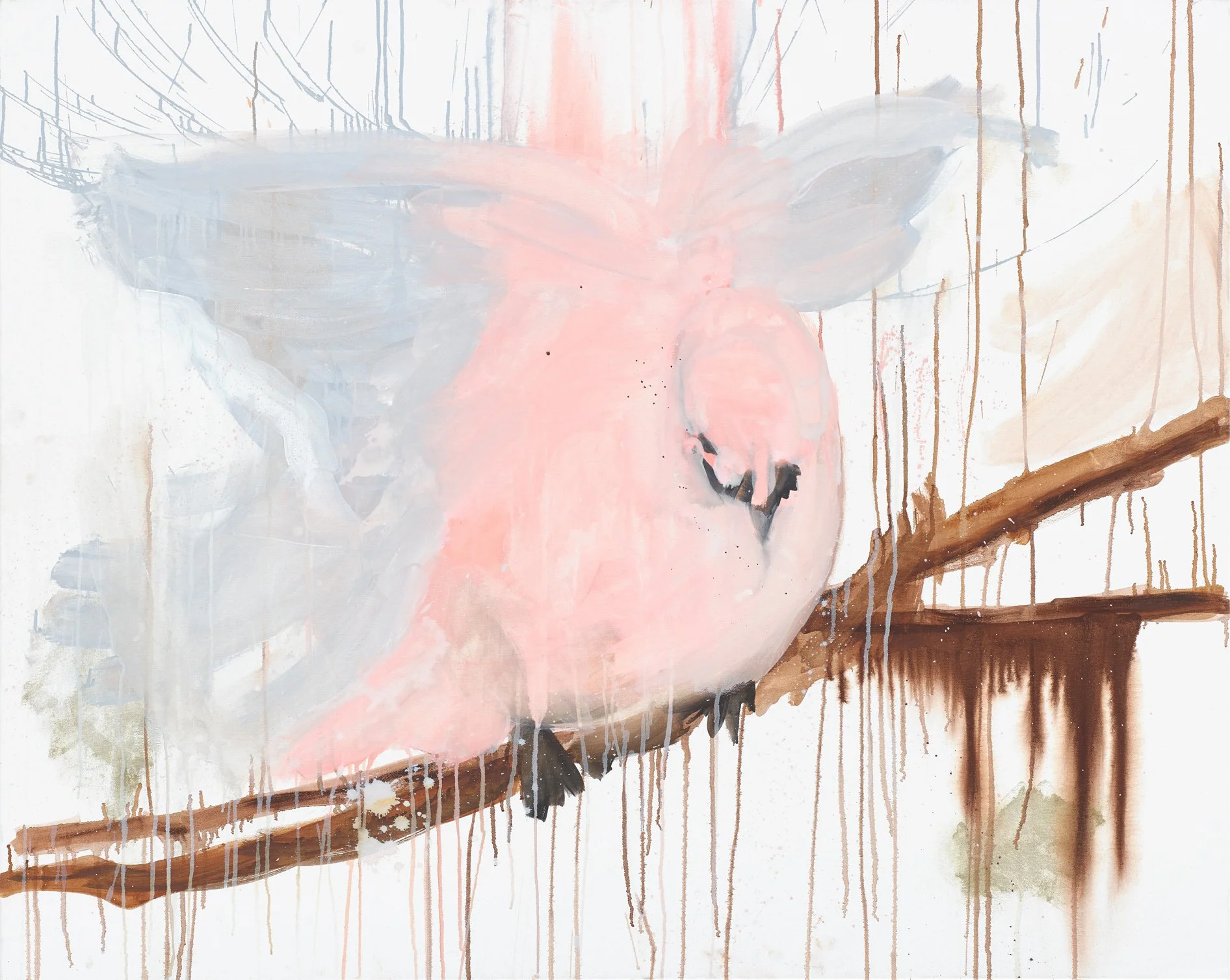
Ersatz Primitiv, oil on canvas, 120 × 150 cm
Colour
Birkedal’s works from 2017–18 draw their energy and intellectual tension in part from the fact that colour is distilled through the artistic process.
Colour does not determine the picture.
The process of the picture decides the colour; it demands particular values.
A constructive order may initially form around a preliminary drawing, but the painting soon departs from it.
Birkedal exchanges the security promised by definition for the openness promised by formation.
The astonished observer does not yet know what something is: a flower, a house, a bouquet, game, a room.
Painting becomes a way toward seeing once the conventional visual and conceptual vocabulary of things has been exhausted or, conversely, overwhelmed by the digital explosion of semantic overdetermination.
In this situation, the observer the one who waits becomes the genuinely radical figure.
She does not contradict the meanings that surround us. Instead, she enters into the unresolved questions of the process:
Why is this this and not something else?
Painting does not direct the search toward something supposedly hidden behind a curtain or beneath the surface.
Instead, it makes us feel the weight of formation itself.
Colour presses itself into the eye.
The painting unsettles us through the movement it introduces into what initially appears static.
Colour becomes the meaning of the surface.
Adding, removing, intersecting, superimposing planes and layers.
The picture arrives at a colour-form in which the many individual stages of its development often remain visible and readable.
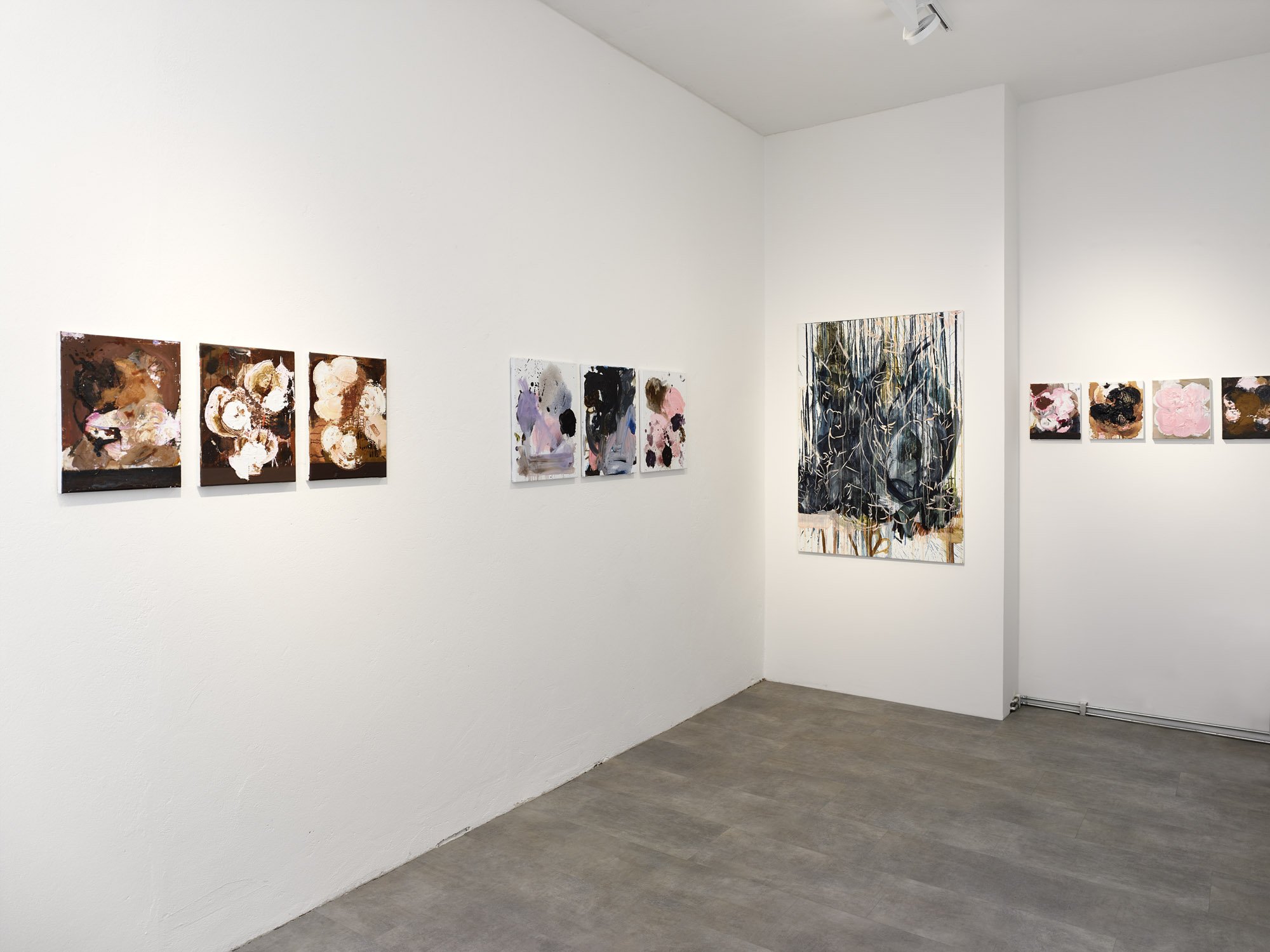
installation view, courtesy of Galerie 1214
Two different strategies emerge.
For one group of paintings, Birkedal establishes a framework of strong, dark tones over the ground, repeatedly testing their relationships to one another through neighbouring contrasts and in relation to the painting as a whole.
Even during this first stage she often uses highly diluted paint.
The work frequently begins with the canvas lying flat on the studio floor.
When the canvas is raised, characteristic runs develop as excess paint moves with gravity in the direction of the painting’s inclination.
The fact that these runs often travel in different directions demonstrates that Birkedal keeps the pictorial structure open.
She repeatedly changes the physical orientation of the canvas and uses developments within the surface as starting points for subsequent interventions.
Her statement “I look and look …” therefore functions simultaneously as a description and as an instruction.
The pleasure of the image becomes available above all to the viewer who can unfold again the condensed time contained within it.
Alongside alterations to the basic colour structure, glazing plays an important role.
This is especially evident in applications of titanium white in different densities and consistencies.
They may appear as translucent clouds, broad wiped brushstrokes, or more or less dense veils and overlays.
These may partly follow an earlier form, only to reinterpret it through a semi-transparent layer of paint.
One could say that Birkedal moves in the opposite direction from Matisse in her use of light colour.
Where Matisse could use black to restage light, Birkedal uses pale glazes and alabaster-like translucent bodies as in Ersatz Primitiv to give darker values new significance.
Like a map that directs us through a territory while simultaneously revealing it, colour is continuously re-orchestrated.
Individual colours migrate through different works, exploring their possibilities through variation and through changing contexts according to a logic that can ultimately only be defined through painting itself.
This requires the painter to resist assigning a colour a single fixed function.
Instead, every painting must be approached as a specific situation in which the formal and chromatic vocabulary must be tested again for its validity and suitability.
In the larger formats, recurring browns and greens become particularly noticeable.
They appear prominently in the painting dedicated to Charlotte Salomon, L’ermitage was not the sanctuary it promised to be, where they operate almost like an ostinato in dialogue with brighter, more striking colours.
These colours create spatial and perceptual shifts without resolving into conventional perspective.
Another group of works is represented particularly by the Berlin Flower Series (2014–2018).
Here Birkedal engages with the imagery of Spanish and Dutch Golden Age and Baroque still lifes and interiors.
Through the colour strategies described above and through a decisive movement toward abstraction, these paintings perform a double movement.
They touch upon the interior and, with it, the act of inhabiting building, dwelling, thinking without fixing it.
Arrangements are bound together and then dissolved again.
They are placed, gathered, infused with atmosphere in the tradition of their historical models and then, in another manifestation of the cycle, cooled almost to absolute zero.
In this way Birkedal develops a vocabulary around the comfort and instability of inhabitation, a vocabulary that is also carried into the larger-format works.
The impossibility of dwelling and the precariousness of dwelling become existential questions.
The nomadic condition produces longing and, simultaneously, fear.
Against the emotional necessity of settling down under frequently difficult and questionable economic and social conditions comes the dissolution of order, followed by its reorganisation into another form.
Within the Berlin Flower Series, the more impasto application of paint familiar from earlier phases of Birkedal’s work becomes increasingly prominent again.
Brushes and, at times, palette knives are used for thick applications of strong colour.
Some passages follow the movement of painting in parallel lines, strings or streaks, while others merge more intimately.
The density of the impasto can give the surface an almost relief-like character and creates particular intensity within the more intimate formats.
These works become chamber pieces within a larger serial structure, capable of testing subtle differences of atmosphere.
Birkedal sometimes uses the primed canvas itself as a ground.
In other works, the flower arrangement is situated within a fictional space through a differently coloured background and a pedestal-like surface on which the arrangement is placed, as in Gawkey.
She also uses deliberate perceptual reversals.
In Palpable Poignancy, for example, the visibly positioned body of the vase appears in a dark brown yet remains transparent, while the densely layered bouquet is rendered in impasto.
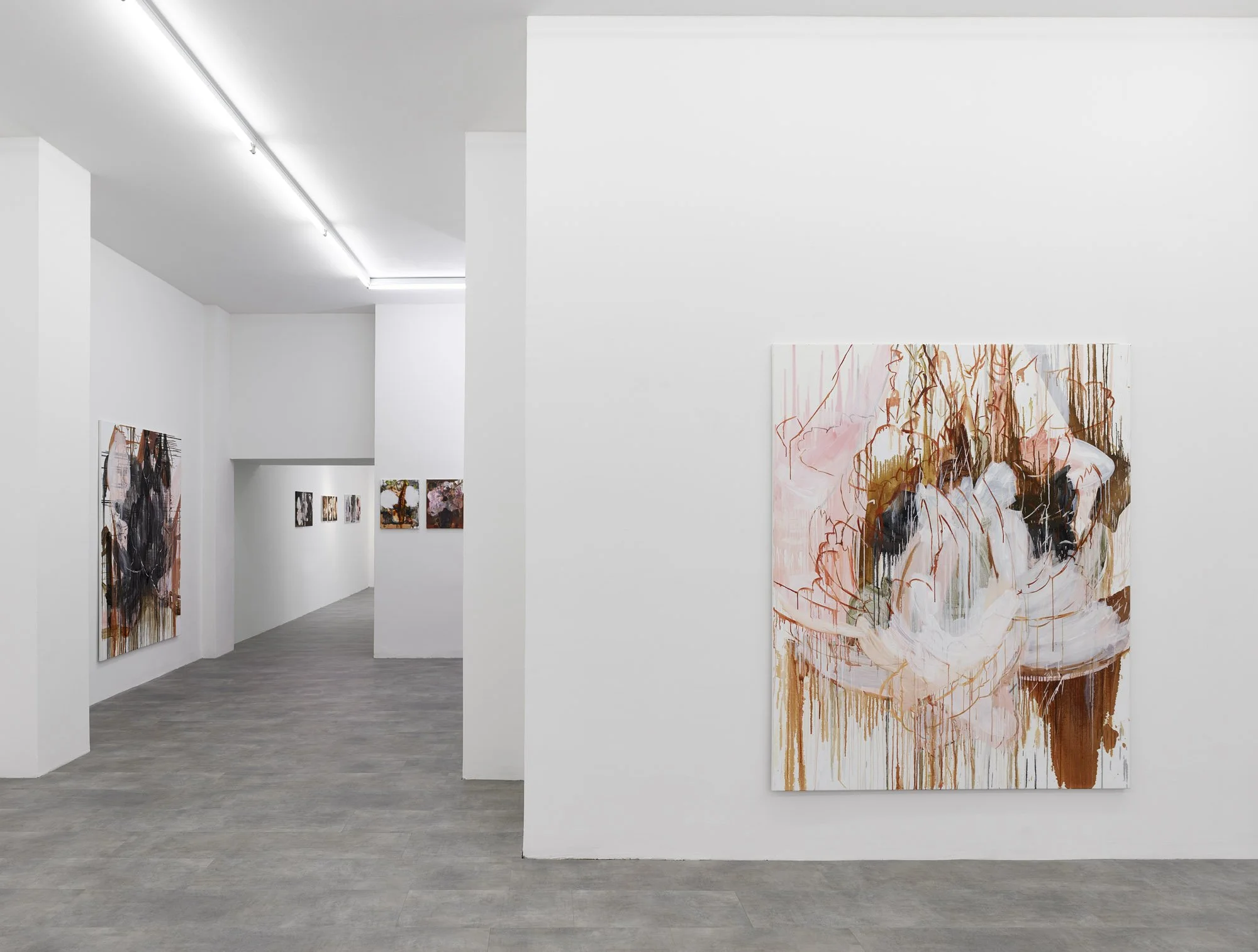
installation view, courtesy of Galerie 1214
Savage Glitter
Birkedal takes the title of the April 2018 Berlin exhibition, Savage Glitter, from Joy Williams’s novel The Quick and the Dead.
The phrase points toward the tension between the romantic wilderness and society ornament, tinsel, glitter two apparently opposing poles toward which we may nevertheless feel simultaneously drawn.
At some point or suddenly the stories that explain everything cease to be believable.
Images built around stories, images that believed they could or were required to narrate something, have increasingly lost ground within modernity.
Or they have had to conquer new territory.
Birkedal has engaged intensively with the question of representation.
She has reflected on Agnes Martin’s emphatic privileging of composition over colour and of pure beauty over nature, but she does not regard representation as a taboo.
Instead, she approaches it as a field of interest and as an anthropological dimension.
Her refraction of the photographic image through diptychs combining photography and abstract acrylic painting in New Mexico 17 Years After (2010), or in the Booth series (2011), can already be understood as a response to doubts surrounding purely compositional strategies.
One conclusion appears to be that formal reflexes may be suppressed, but the contents of human existence scenes from everyday life return like revenants, even when they are not transformed into narrative.
Birkedal brings these existential elements, which we continually organise through our own stories, onto an open stage where the viewer must encounter them without being provided with a script.
Flower arrangements, interior scenes from the intimacy of domestic life, compositions reflecting traditions of Spanish and Dutch still life, rituals and remnants of everyday existence activate again the old dialectic between public and private.
What becomes of our rituals of encounter, our recurring celebrations and civic occasions?
Does the private realm the interior continue to belong to a historically gendered sphere, or does the impulse toward formation instead dissolve those inherited attributes?
Is the flower arrangement “residual nature” wilderness?
Is it an echo of the “reactionary nuclear family”?
Or might it become something else entirely: perhaps a liberated reworking of the vanitas motif, entering a free process of reinterpretation and, provocatively, dressing itself in glitter?
Marie Birkedal approaches such objects through painting without handing the viewer a script.
Colours themselves cannot simply function as metaphors.
Yet white, acting as a moderator of colours, can as in Birkedal’s work test the literal character of colour and destabilise the apparent uniqueness of things behind a veil of uncertainty.
The taboo was, first ethnologically and later psychoanalytically, that which could not be touched.
Birkedal reveals through concealment: through glazing, wiping, covering and deconstructing.
Only then do we know:
something is there.
Dr. phil. Peter Kohlhaas
© Galerie1214, 2018
https://www.idoart.dk/kalender/marie-irmgard-savage-glitter
https://mail.bpigs.com/spaces/galleries/galerie1214
https://prettybluroffashion.wordpress.com/2018/05/02/gallery-weekend-berlin-meine-highlights/