Tropismen
Tropismen, Galerie1214, Berlin / Bad Dürrheim, 2021
Conceived and edited by Dr. phil. Peter Kohlhaas
With works by artists presented by Galerie1214 in Berlin and Bad Dürrheim.
Supported by Stiftung Kunstfonds as part of NEUSTART KULTUR.
Text: Dr. phil. Peter Kohlhaas
Original German catalogue available as PDF.
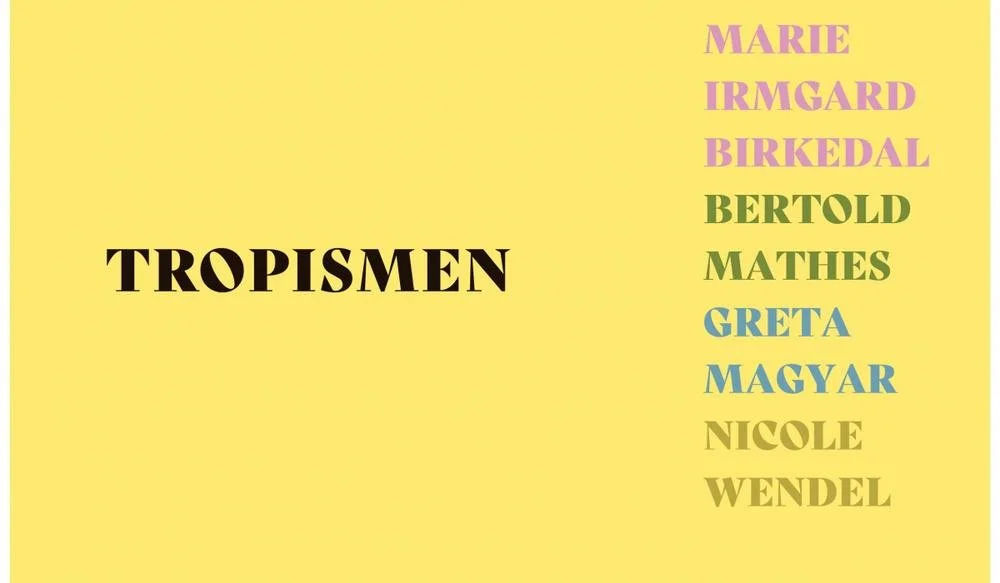
TROPISMEN
This catalogue brings together a cross-section of artistic positions to which Galerie1214 has been able to give space in recent years through installations in Berlin and Bad Dürrheim, and which it currently presents.
As artists have done in previous exhibitions, we have once again borrowed a title from another field for this presentation: “Tropisms.”
As so often happens, it is precisely the distance created by such a borrowing that can set the works in motion within an open field of thought. In biology, the term tropism describes the orienting movements of organisms in response to light, warmth and nutrients. It refers to the continuous, subtle “readjustment” of living beings within their respective environments, including their responses to the world and to other living beings around them.
One implication of this understanding lies in the juxtaposition of self-sufficient entities and structures and patterns that are always already symbiotic. While the former are defined by the poles of difference and selfhood, the latter are characterised by an interplay of separation and openness, mediated through the spontaneous activity of the senses and its absorption into reflection.
PRIMARY EXPERIENCE: LIGHT
With his frequently quoted and much-debated idea of the sun-like nature of the human eye, Johann Wolfgang von Goethe described the view that a tropism such as the eye’s orientation towards light cannot be fully explained by a purely materialist stimulus-response model.
Rather, our understanding is held, as it were, by two intertwined strands: one leads through sensory experience, the other through culturally mediated concepts, often developed over long periods of time.
Although, to remain with the example of light, the sun has been incorporated over thousands of years into conceptual systems and rituals — as the god Ra, abstracted as a “celestial body,” or ultimately classified as a hydrogen-fusing dwarf star — light and warmth nevertheless remain directly and bodily accessible to us as primary experiences alongside our knowledge about them.
Art follows the traces of these experiences: in drawing, as a knowledge-producing dialogue between contour and surface; in the illusion of space, as a process of establishing dimensions and order; and in colour, as a correlate of inexhaustible emotional nuances.
ZERO POINT OF FREEDOM
Orienting ourselves towards something outside ourselves creates a kind of tension, comparable to the positive muscular tension from which movement begins.
Although such tension fulfils its purpose through its eventual release, it retains a particular echo in art. What continues to resonate within a work exerts a special attraction, just as the reverberation of a choreography can remain compelling after a performance has ended.
Once a work of art has been made, it can be understood, in the act of viewing, as a “zero point” — to borrow Roland Barthes’s term — of freedom: the freedom of feeling and creating on the side of production, and of seeing and feeling on the side of reception.
MANIFESTATION OF THE SERIES
The manner in which something is made inevitably reveals something about the spirit behind the selection of works presented here, a selection concerned with the elemental quality of making itself.
It begins with the event of formation, which always has a point of departure, and follows the traces that reveal how making can lose itself in what is foreign in order to rediscover what is its own — although, loosely following Bertolt Brecht, in another and unexpected place.
We do not exchange supposed nature for art because, unlike natural tropisms, art is not merely embedded in artistic creation. As an intelligible social practice, its meaning lies precisely in the way free expression and discipline reflect one another.
Art can therefore be understood as a process in which creative spontaneity and reflection are made to act upon one another within arranged scenarios of self-experience.
In short: reflection is already present in the image.
Every image stands on its own as a work. Yet in viewing it there is a particular appeal in following the coordination of tension and relaxation through serial variations of technique or recurring motifs, or in entering into the permutations of a chromatic alphabet.
Artistic practice summons the elemental spirits for us, gives itself over to their play, and at the same time orchestrates them.
ACKNOWLEDGEMENT
The Tropismen project is funded by Stiftung Kunstfonds as part of the NEUSTART KULTUR support programme initiated by the Federal Government Commissioner for Culture and the Media. We thank the foundation and its jury members for their support.
© Text 2021: Galerie1214
Dr. phil. Peter Kohlhaas